
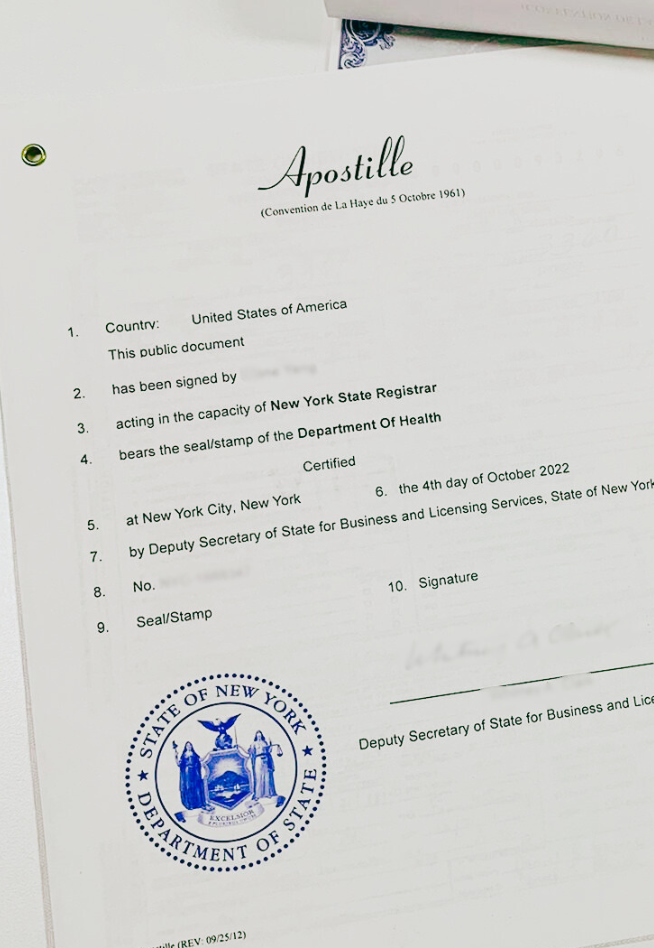
What They Are, Why They Matter, and How Requirements Can Vary
When applying for Italian citizenship or an Italian visa, your documents must often be recognized as legally valid abroad. This is where apostilles, legalizations, and certified translations come into play.
These steps can feel confusing — especially because requirements vary depending on the country of origin, the Italian consulate, and the type of application. Understanding what each of these terms means can help you avoid delays, rejections, or costly rework.
What Is an Apostille?
An apostille is a form of international authentication that certifies the origin and legitimacy of a public document (such as a birth certificate, marriage certificate, or criminal background check).
Apostilles are issued under the Hague Apostille Convention, an international treaty that simplifies document recognition between participating countries.
When is an apostille required?
Apostilles are commonly required for:
● Italian citizenship applications
● Visa applications
● Family reunification
● Vital record registration in Italy
In most cases, any foreign public document used in Italy must be apostilled or legalized before it can be accepted by Italian authorities.
What If My Country Is Not Part of the Apostille Convention?
Not all countries are members of the Hague Apostille Convention.
If your document was issued in a non-member country, it cannot be apostilled. Instead, it must go through a legalization process, which typically involves:
1. Certification by the issuing authority
2. Additional authentication steps
3. Legalization by the Italian consulate with jurisdiction over that country
This process is often longer and more complex than obtaining an apostille, which is why identifying the correct path early is essential.
What Is a Certified Translation?
In addition to obtaining an apostille or completing the legalization process, your document will also likely need to be translated into Italian and properly certified. This is a separate step from the apostille or legalization itself. While an apostille or consular legalization confirms the authenticity of the document, a certified translation ensures that Italian authorities can accurately review and accept the document’s contents.
A certified translation is a translation that is officially declared to be accurate and complete. For Italian immigration and citizenship processes, documents issued in a foreign language usually must be translated into Italian.
However, translation requirements vary by Italian consulate and application type.
Translation Requirements: Why They Vary by Consulate
Italian consulates have independent discretion when it comes to translation rules. As a result:
Some consulates require translations to be completed by a translator listed on the consulate’s official website
Other consulates allow the use of any accredited or professional translator, provided the translation meets specific formatting and certification standards
Because of these differences, using the wrong translator — even if the translation itself is accurate — can result in rejection or requests for resubmission.
Translations Completed in Italy (Sworn Translations)
Another option is to have documents:
● Translated in Italy, and
● Sworn in court (traduzione giurata) before an Italian official
A sworn translation in Italy is legally recognized and is considered the equivalent of a certified translation for Italian authorities.
That said:
In many cases, consular-certified translations are preferred, especially when applying through an Italian consulate abroad
Some consulates explicitly require translations to be certified by them, even if a sworn translation exists
Choosing the correct approach depends entirely on where and how your application is being submitted.
Why Getting This Right Matters
Apostilles, legalizations, and translations are not interchangeable — and mistakes in this area are among the most common causes of application delays.
Using the wrong process may result in:
● Rejected documents
● Additional fees
● Missed appointment windows
● Significant processing delays
This is why it’s important to confirm requirements before requesting apostilles or translations.
How We Help
Navigating apostilles, legalizations, and translation requirements can be one of the most confusing parts of an Italian citizenship or visa application — especially when rules vary by country and consulate.
Our team provides end-to-end support to ensure your documents are prepared correctly and accepted the first time.
We can assist with:
● Determining whether your documents require an apostille or consular legalization
● Confirming consulate-specific translation and certification requirements
● Coordinating professional Italian translations for your documents
● Certifying translations in accordance with the requirements of your application
● Arranging sworn translations in Italy, when appropriate
● Reviewing all documents for compliance before submission
By managing the translation and certification process on your behalf, we remove the guesswork and help prevent costly delays or rejections.
If you’re unsure which authentication or translation method applies to your case, or would like us to handle translations and certifications for you, contact our team for personalized guidance.
