
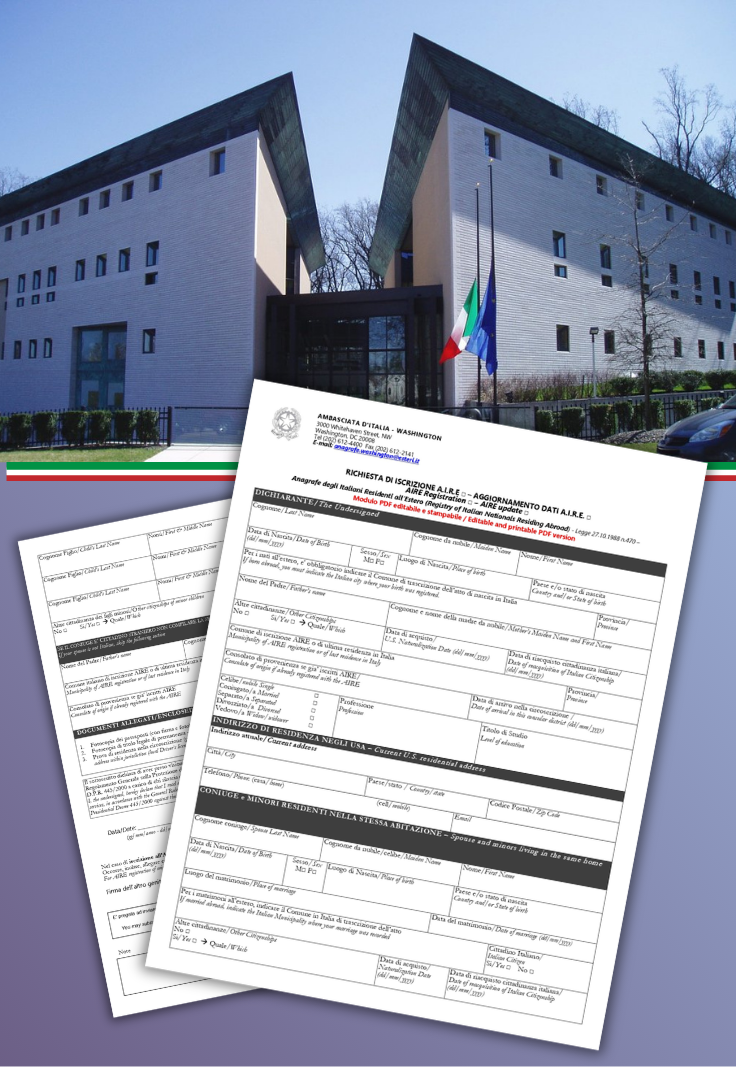
The Registry of Italian Citizens Residing Abroad, also known as AIRE, is a mandatory registration for all Italian citizens residing outside of Italy. Below, we have answers to some of our most frequently asked questions regarding AIRE.
1. What is AIRE?
Established by Law 470/1988, AIRE keeps track of the personal data of Italian citizens residing abroad. It is mandatory, and is handled by both local municipalities and Italian consulates.
2. Who should register with AIRE?
Every Italian citizen residing abroad for longer than 12 months is required to register with AIRE. Even if you have not been outside of Italy for 12 months, the obligation applies if you intend to relocate for more than 12 months. More specifically, registration should occur within 90 days of moving. This includes people who acquire Italian citizenship outside of Italy, for example, by blood or by marriage. It also applies to minors.
AIRE does not apply to those who only intend to remain outside of Italy for less than 12 months, Italian government officials stationed abroad, and members of the Italian Armed Services stationed at a NATO post.
3. Is it obligatory to register with AIRE?
Yes. In fact, there is a fine ranging from €200 to €1,000 per year of non-registration. Effective January 2024, it is not retroactive. Penalties will only be brought forward from up to five years of non-registration. Registration with AIRE itself is free, however.
It can be useful to notify your Italian municipality that you will be leaving prior to the actual move. This way, they can begin the registration process before you formally begin your request at the consulate. It is still important to make your consular declaration within 90 days of moving.
4. What are the benefits of AIRE?
The primary benefit of registering with AIRE is ensuring access to consular services. For those with dual citizenship—for example, in the case of U.S. citizens who acquire Italian citizenship—Italian consular services might be limited while the person is residing in the country of their other citizenship. For example, a dual U.S.-Italian citizen might have limited assistance from Italian consulates while the person is living in the U.S. This does not mean that services such as obtaining a codice fiscale or applying for an Italian passport at Italian consulates will be overly difficult however.
Another benefit is the ability to continue to vote in Italy’s national elections while residing abroad.
Finally, you can easily obtain or renew Italian documents, and register the foreign births of children, while being registered with AIRE.
5. Which municipality will I register with?
The Italian municipality that will hold your registration along with your Italian consulate abroad, will be the municipality you last resided in in Italy before your move. In the case of those who obtained Italian citizenship abroad and have not resided in Italy, this will be the municipality that holds your birth certificate, most likely the municipality of your Italian ancestor.
6. How to register with AIRE?
In general, you will need to fill out an application, provide a copy of your Italian passport, and proof of the legal stay in your new country (e.g. passport for that country, visa, etc.) You will also need to provide proof of residence, such as a utility bill or rental contract. Be sure to update your records in the event that you move. Check your local consulate too for more specific guidelines, as documentation could change depending on jurisdiction.
7. What if I change consular jurisdictions?
If you remain outside of Italy and move to a new location under a different consular jurisdiction, you will need to register your AIRE documentation with the new consulate. For U.S. consulates, this can usually be done by updating your information on the Fast It portal you used when initially registering. Aside from changing addresses, updates also need to be made if there are any major changes in personal circumstances (e.g. marriage, divorce, birth, etc.), or if you lose Italian citizenship. Check the information of your new consulate to see their particular requirements. Updates need to be made within 90 days of moving.
8. What if I move back to Italy?
If you move back to Italy, all you need to do is register your residence at your new municipality, a requirement even if you relocate within Italy.
9. Can I still access Italian healthcare?
No. Once you move your residence outside of Italy, you will no longer have access to Italy’s national healthcare system. You will, though, have access to emergency services during short visits to Italy, up to 3 months.
If you have further questions or would like assistance with AIRE registration, contact us today at [email protected].
