
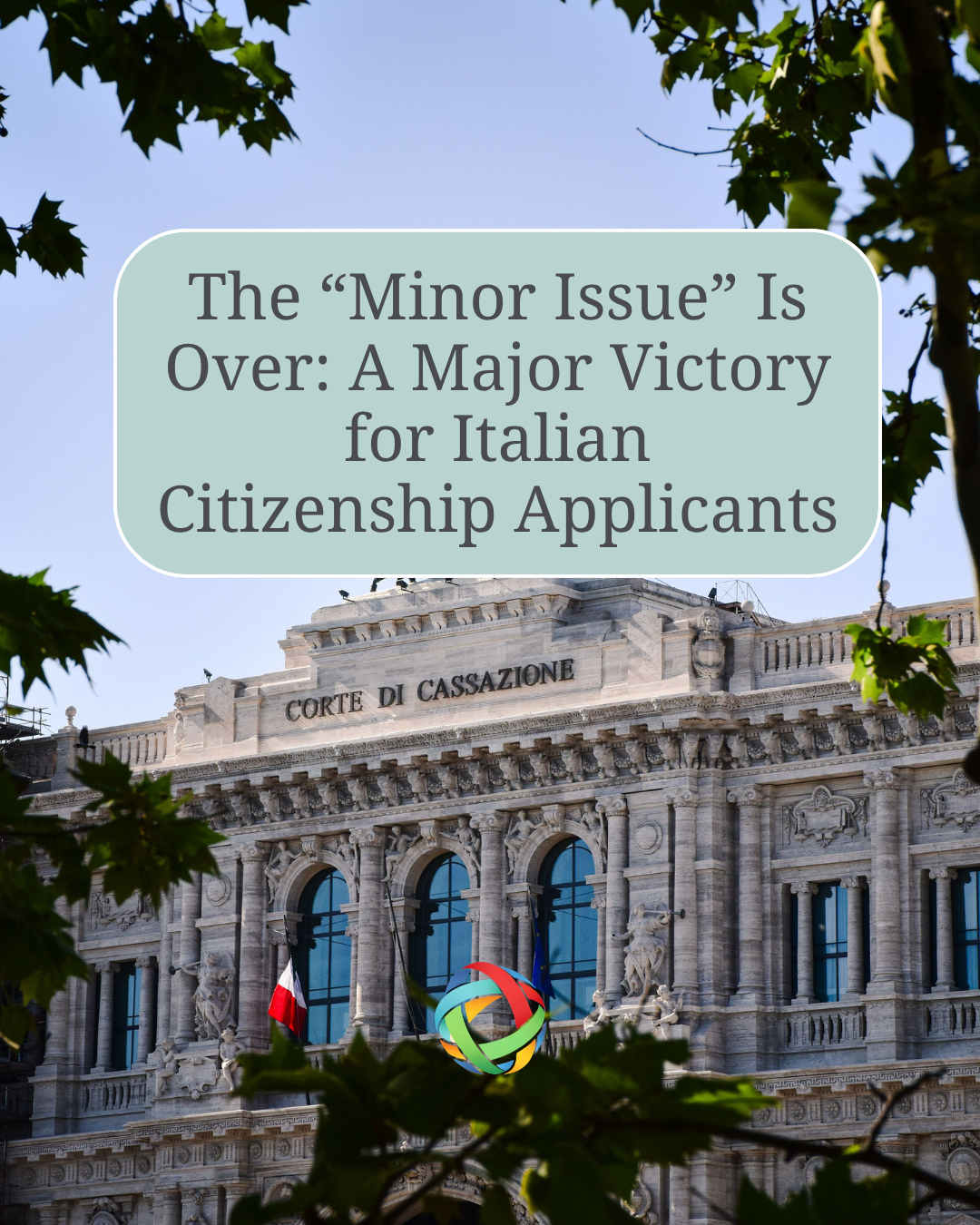
In a major victory for Italian citizenship applicants and the recognition of citizenship rights through ancestry, Italy’s Court of Cassation (the Italian Supreme Court), has ruled against the controversial “minor issue.” For thousands of applicants seeking Italian citizenship through jure sanguinis (citizenship by descent), this issue has caused widespread confusion, debate, and uncertainty, ultimately creating significant legal obstacles for many applicants.
What Was the “Minor Issue”?
The controversy stems from the interpretation of Articles 7 and 12 of Law No. 555 of 1912. For over a century, standard legal practice protected children born abroad who held dual citizenship from birth (jure sanguinis from an Italian parent and jure soli from the birth country, such as the US, Brazil, or Argentina). Under the original intent of Article 7, if the parent subsequently naturalized as a citizen of another country while the child was still a minor, the child did not lose their Italian citizenship.
However, a sudden legal shift occurred following controversial rulings by individual panels of the Supreme Court, which led to administrative measures like Circular No. 43347 of 2024. The Ministry of the Interior issued the above mentioned “circolare” to instruct consulates and local municipalities to change how they interpreted citizenship by descent in cases where an Italian citizen naturalized while their descendant—the next person in the citizenship line—was still a minor. Under the new interpretation established by the circolare, if a parent naturalized in a foreign country while their child, the next person in line, was still a minor, the Italian citizenship line was considered to have been interrupted. If the parent lost Italian citizenship through naturalization, the child was also considered to have lost Italian citizenship. This effectively prevented many descendants affected by the “minor issue” from claiming recognition of Italian citizenship through that family line.
The Court of Cassation and Its Ruling: A Return to 100 Years of Precedent
The Court rejected the interpretation set out in the memo issued by the Ministry of the Interior, establishing that Article 7 protects any minor who held dual citizenship from birth—in other words, any child born abroad to an Italian citizen—from losing Italian citizenship due to subsequent changes in either parent’s citizenship.
This is significant for two main reasons:
The Italian Supreme Court (United Sections) has greater authority than any other Italian civil or criminal court, aside from the Constitutional Court, which presides specifically over issues concerning the Italian Constitution. With this essentially being the highest court in the land for civil and criminal matters, its ruling establishes the authoritative interpretation of the law that lower courts and public authorities are expected to follow. In simple terms, the “minor issue” is no longer an unresolved legal issue—it has now been settled by Italy’s Supreme Court.
Second, applicants who were previously affected by the “minor issue” may no longer be automatically disqualified on that basis and may now be able to proceed with claiming Italian citizenship where they would previously have been denied because of this interpretation.
In short, The Court reinstated the century-old principle that served Italian diaspora families uninterruptedly since 1912.
What Happens Next? Looking Ahead
While this ruling provides relief for applicants who have had to seek Italian citizenship through judicial alternatives, such as filing a lawsuit, some broader administrative questions remain.
It remains to be seen how quickly Italian consulates and local municipalities, or comuni, will update their internal directives to reflect this ruling. They will, however, be expected to do so, considering that this ruling comes from the Supreme Court and, moreover, from the United Sections of the Supreme Court, that is specifically tasked with resolving conflicting precedents.
Another landmine to navigate with this new ruling is how it will be applied in conjunction with the infamous Tajani Decree, especially as its broader provisions face ongoing constitutional and European legal challenges.
Conclusion
This landmark ruling represents a major victory for Italian citizenship applicants affected by the “minor issue.” By rejecting the restrictive administrative interpretation and reaffirming the protections established under Article 7, Italy’s Supreme Court has brought much-needed legal clarity to a question that created uncertainty and barriers for thousands of families.
For anyone whose recognition was previously paused or rejected over the “minor issue,” this decision opens a clear legal path forward.
