
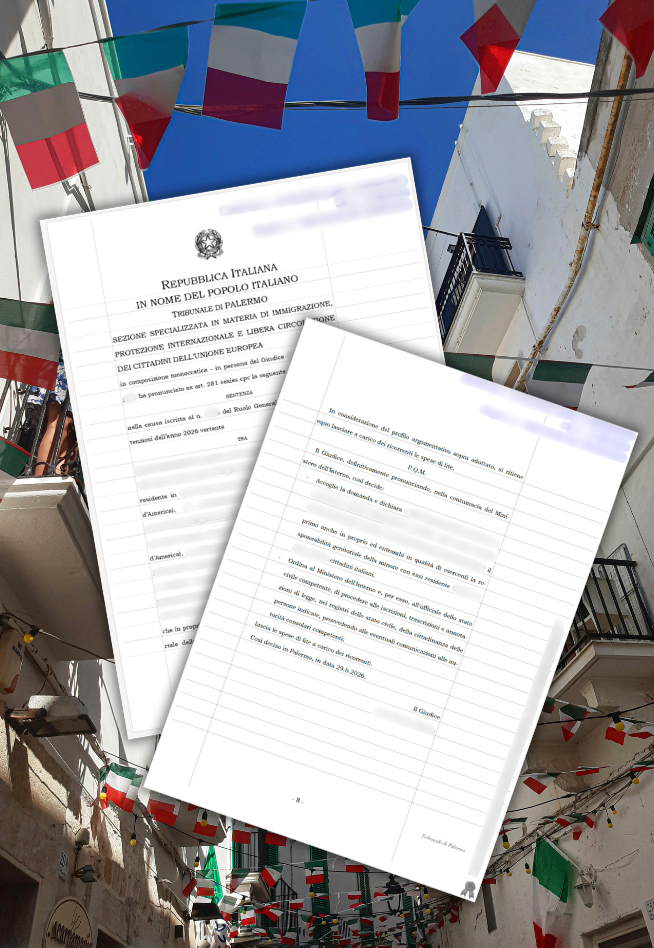
There has been further encouraging progress in the Palermo Court System for individuals whose Italian citizenship applications have been impacted by the Tajani Decree, this time with ICA clients who were not seeing advancement within the consular route. On June 29, 2026 a Palermo judge sided with our clients, claiming that their lineage through their maternal line was valid and that they attempted to obtain their citizenship before the decree deadline, declaring all of them Italian Citizens.
1948 case understanding
Before January 1, 1948, when the Italian Constitution went into effect, Italian Law treated men and women differently. Italian fathers could pass citizenship to their children, but Italian mothers generally could not pass citizenship to children born before that date. When the constitution took effect, it introduced equality principles, including that men and women are equal before the law and that the transmission of citizenship could no longer discriminate based on sex. Unfortunately, the consulates maintained that if a child had been born before 1948 and the citizenship claim was being pursued through the maternal line, they could not approve it administratively. Years later, the Italian courts stepped in and said the old rule was unconstitutional because it unfairly discriminated against women. The Constitutional courts created equity principles, and then in 2009 the Court of Cassation turned those principles into the modern judicial pathway for pre-1948 maternal citizenship cases. The result was that if your line goes through an Italian woman and the next child in line was born before January 1948, you can often still obtain recognition through the courts instead of the consulate, depending on certain situations. This is what has now become known as 1948 cases. So if a female descendant mother lost her citizenship automatically and involuntarily through marriage after her husband naturalized in another country, courts usually treat that loss as invalid and allow transmission. Being able to apply through the court and argue a 1948 case has proved to be essential for our clients.
What happened with our clients?
What is important about this case involving our clients who were applying through their paternal lineage is that they originally had their consulate appointment prior to the March 2025 cutoff when the Tajani decree went into effect. When they approached the consulate with their application they were told that they would be denied based on the male ancestor who had been naturalized while his child was a minor. Our clients withdrew their application from the consulate and decided to try a different avenue. Our lawyers filed for a court date in April of 2026 with the Court of Palermo to have our client’s Italian citizenship by descent jure sanguinis, recognized through their maternal lineage line instead. On June 29,2026, it was presented in court that they were claiming citizenship through their female Italian Ancestor who was born in Sicily in 1896 and who was their great grandmother. Their female Italian ancestor moved to the US and married an Italian man. She acquired U.S. citizenship automatically through marriage, not voluntarily. They had a son in 1916, which previously allowed citizenship that passed down through later generations to the ICA clients. But their male ancestor became a US citizen in 1921 while his son was still a minor. Fortunately, the ruling was not based on the paternal line, avoiding the need to wait for Italy’s Supreme Court to clarify the unsettled legal question surrounding the “minor issue”. Instead, the judge said that because the maternal ancestor’s American naturalization through marriage was involuntary, he treated it as legally ineffective and therefore the client’s citizenship line never broke. As stated earlier, due to prior Supreme Court rulings automatic loss of Italian citizenship is considered unconstitutional and treated as though it never validly interrupted citizenship transmission. It is important to state that while the judge upheld the basis of the Tajani decree and recognized that their court case was not filed until after the March 2025 cutoff date, he found that our clients fell under two specific exceptions within the decree. One of which included that they already had tried with the consulate and had obtained an appointment before the decree had been established and were unsuccessful administratively. On that basis, he allowed their case to be heard and applied under the pre-decree rules. So by the court applying the old citizenship rules as well as using maternal lineage, and claiming that they had acted in time administratively, the judge granted their request. They were declared Italian citizens, and the judge ordered the Ministry of Interior and civil registry offices to complete the registrations and notify the appropriate consulates.
What this means?
For our clients, this decision resulted in the recognition of their Italian citizenship and reaffirmed that prior efforts through the consular process were not disregarded. This decision represents another important development for individuals whose citizenship pathways have been disrupted by the Tajani Decree. While each citizenship case depends on its own facts and legal circumstances, this Palermo ruling illustrates how constitutional principles can truly shape the outcomes in the Italian courts.
Conclusion
If you would like your case for citizenship analyzed, or have further questions related to 1948 cases, we’re here to help! Contact Italian Citizenship Assistance today at [email protected].
