
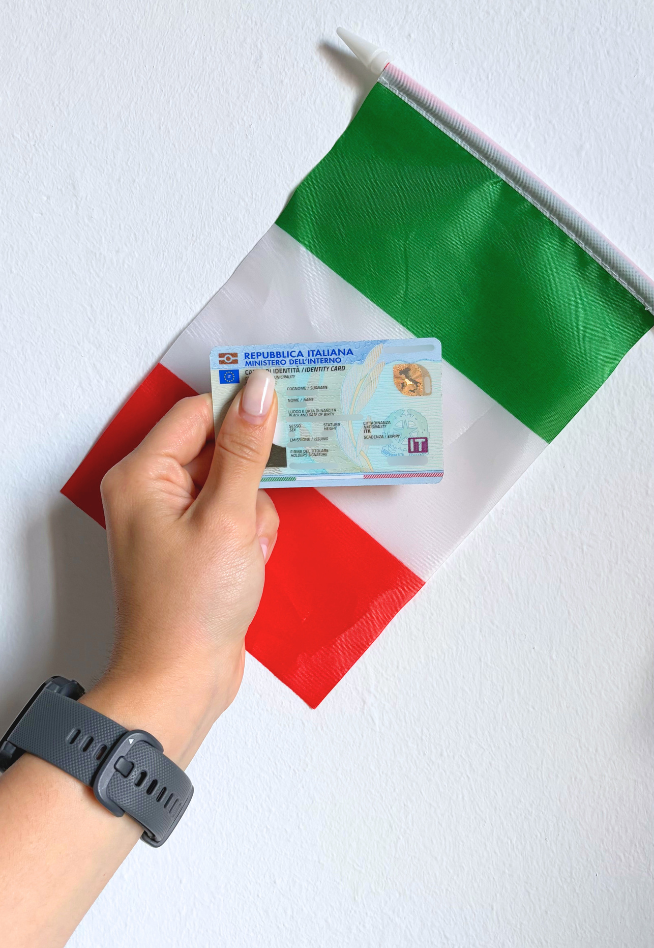
As of June 1st, there has been more flexibility introduced in obtaining an electronic identity card (CIE) for Italian citizens residing abroad. In the article below, we cover what the CIE is, the benefits it provides, and what has changed for those registered with A.I.R.E.
What is the electronic identity card?
The Italian electronic identity card is an identification document issued by the Ministry of Interior. Apart from being an important means of identification for Italians (and non-Italians residing in Italy), it comes with special security and anti-counterfeiting features. Most importantly, it provides you with credentials to access important bureaucratic sites used in Italy, such as for healthcare documents. Access to such sites is particularly important for Italians residing abroad, who otherwise could not easily go into a physical office.
One can apply for CIE at a local municipality or Italian consulate abroad. You will need a passport photo, either your old CIE (if renewing) or another valid ID document (if obtaining for the first time), your codice fiscale, payment of €16.79 if applying in Italy or €21.95 if applying at a consulate, and an address. You will also be fingerprinted at the time of the appointment.
The validity of the card is 3 years for children under 3 years of age, 5 years for children between 3 and 18, and 10 years for adults. In the case of applying on behalf of a minor child, both parents need to be present, or the absent parent will need to sign a form in advance.
Difference between CIE and SPID
There is another digital identifier in Italy known as SPID (Sistema Pubblico di Identità Digitale) that is essentially used for the same purposes as CIE, that is, accessing bureaucratic websites for personal use. Unlike CIE, SPID is not tied to an identity document, but rather consists of a username and password and is provided by a third party, such as the phone company TIM, Poste Italiane, or the digital services company Aruba. Some of these providers offer a way for those who live abroad to confirm their identity to set up SPID, such as through webcam. However, if there is an issue with your SPID or an important update that requires the assistance of one of the providers, getting in touch could be difficult for those who are abroad. This makes CIE a much more attractive option.
It is perfectly acceptable to have only one or the other, depending on which is more convenient for you to set up and maintain.
How to request the CIE (for those residing in Italy)
To apply in Italy for an electronic identity card, you will need to bring the documents listed above to your municipality of residence, where you will also be fingerprinted. It is important to note that if you are residing in Italy, then you must be an officially registered resident. You will have the choice to either pick up the card in person or have it delivered to your residence, along with the credentials needed to activate CIE online. To do this, you will need to file an application with your local municipality, and the police will check the residence at a later date to ensure you live there.
June 2026 change gives more flexibility for Italians residing abroad
Previously, Italians residing abroad could only request CIE at their local consulate. As of June 1, 2026, this has changed. Now all Italian citizens registered with A.I.R.E. can request their CIE at any Italian municipality. The card can then be collected in person at the municipality or shipped to the person’s address abroad. This provides significant more flexibility in the process.
Conclusion
Italian Citizenship Assistance is happy to help with any part of your Italian relocation process. Contact them today at [email protected].
